The Real Bottleneck in M&A Diligence Isn't the Documents. It's the Workflow.

Key Takeaways
- •The bottleneck in M&A diligence is workflow, not volume. Attorneys lose days to fragmented tools, not difficult legal questions.
- •AI that reviews documents without citing sources is a liability. Every finding must trace back to specific contract language.
- •The most effective diligence teams treat AI as a first-pass analyst, not a replacement for judgment.
- •Structured extraction (tabular views, clause-level analysis) outperforms chat-based Q&A for contract review at scale.
Most legal teams lose days not because they lack information, but because they lack a system for processing it. Here's how AI-powered document review is changing that.
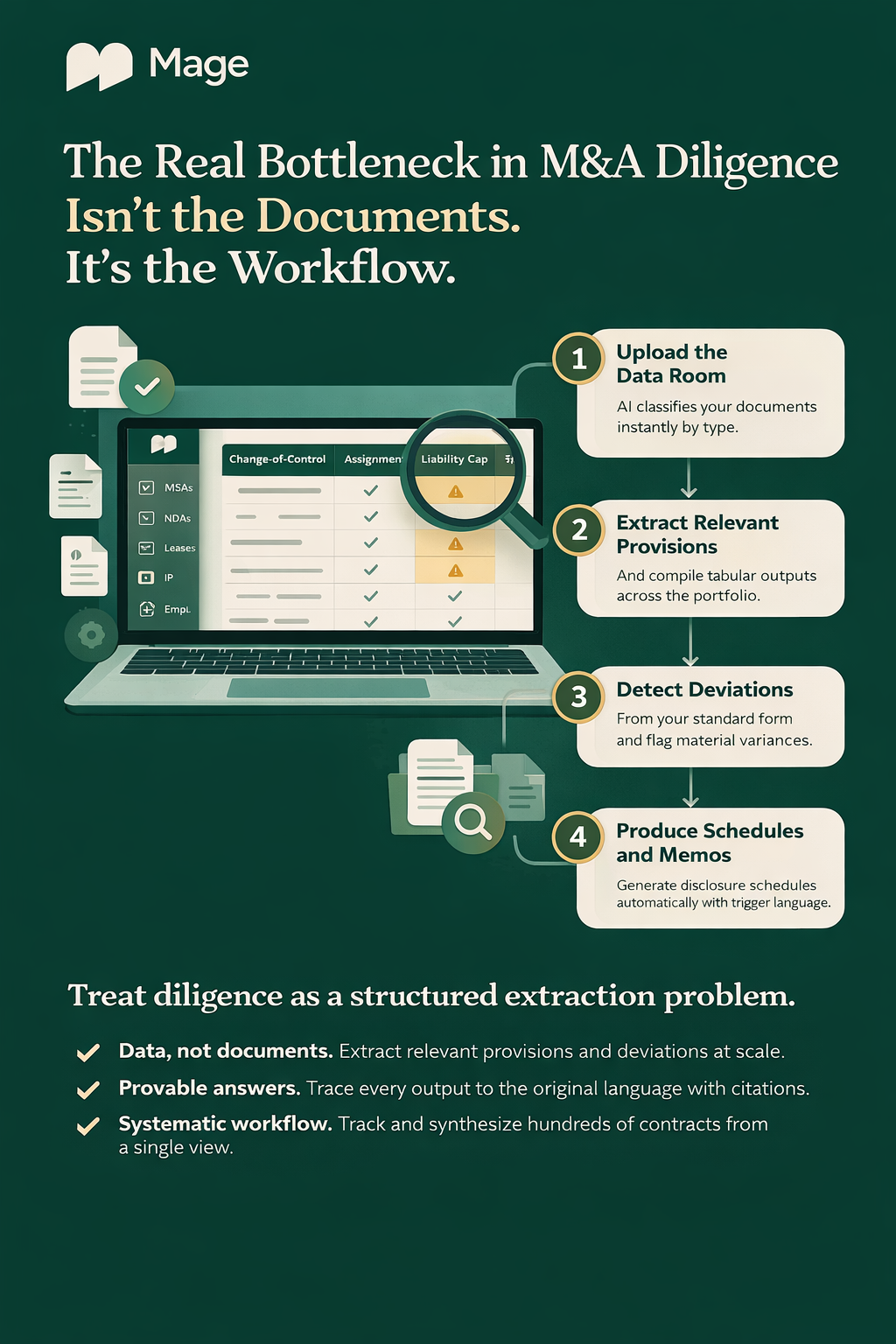
The 500-Document Problem
A partner sends you a data room link on Monday morning. Inside: 487 contracts. Customer agreements, vendor MSAs, license terms, NDAs, employment agreements, IP assignments, leases. The buyer wants a diligence memo by end of week.
You know the drill. Open each document. Skim for the provisions that matter: change-of-control clauses, assignment restrictions, liability caps, indemnification carve-outs, termination for convenience. Flag anything unusual. Synthesize it all into a memo, a set of disclosure schedules, and a closing checklist.
The legal analysis itself is rarely the hard part. Most experienced M&A attorneys can assess a change-of-control provision in seconds once they find it. The hard part is finding it, across hundreds of documents, while tracking which contracts you have reviewed and which you have not, and doing it accurately enough that nothing slips through.
This is the real bottleneck in M&A diligence: not the thinking, but the workflow around the thinking.
Why Chat-Based AI Falls Short
When attorneys hear "AI for document review," many picture a chatbot. Upload a contract, ask a question, get an answer. And for a single contract, that can work.
But M&A diligence is not a single-document problem. It is a portfolio problem. You need to review hundreds of contracts, extract the same provisions from each, compare them against a standard form, identify variances, and produce structured outputs: matrices, schedules, memos. You need to do this consistently, with citations, under time pressure.
Chat-based AI tools struggle here for three reasons:
They are reactive, not systematic. You have to know what to ask, document by document. That means you are still doing the mental work of tracking what has been reviewed and what has not.
They lack structured output. A chatbot gives you prose. M&A diligence requires tabular data: which contracts contain assignment restrictions, what the liability caps are across the portfolio, where the consent requirements live. Prose does not scale.
They obscure provenance. When a chatbot summarizes a contract, you often cannot trace the answer back to specific language. In a transaction where accuracy is everything and the buyer's counsel will scrutinize your disclosure schedules, that is not acceptable.
A Different Approach: Structured Extraction at Scale
The teams we work with at Mage have moved to a fundamentally different model. Instead of asking AI questions about individual documents, they treat diligence as a structured extraction problem.
Here is what that workflow looks like.
Step 1: Upload the data room and let AI classify
The first step is simple: upload all documents at once. AI classifies each document by type (customer agreement, vendor contract, NDA, employment agreement, IP assignment, lease) and organizes them into logical groups.
This alone saves hours. In a traditional workflow, a first-year associate or paralegal would manually sort and label documents before anyone starts reviewing. Here, classification happens in minutes and the attorney can correct any misclassifications with a single click.
Step 2: Extract provisions across the entire portfolio
Instead of reading each contract end to end, AI extracts the specific provisions that matter for M&A diligence: change-of-control, assignment and anti-assignment, liability caps, indemnification terms, termination rights, consent requirements, exclusivity, non-competes, and more.
The output is not a paragraph of prose. It is a structured matrix: documents as rows, clause types as columns. Each cell contains the extracted provision with a direct link to the source language in the original document.
This is the critical difference. An attorney reviewing 487 contracts can now scan a single view and immediately see: 312 contracts contain no change-of-control provision. 94 require consent. 81 allow termination on change of control. Instead of hunting through documents one by one, the attorney is reviewing findings and exercising judgment.
Step 3: Detect variances from the standard form
In most portfolios, the majority of contracts follow a standard form with minor variations. The contracts that matter for diligence are the ones that deviate.
AI identifies the baseline form automatically when three or more similar documents exist, then flags every substantive variance. Not formatting changes or minor wording differences, but material deviations: a liability cap that is uncapped when the standard is $1M, an assignment clause that requires board approval instead of simple notice, an indemnification provision that carves out gross negligence.
Each variance is categorized by severity and linked to the specific language in both the form and the deviating contract. Attorneys focus their time on the contracts that actually need attention.
Step 4: Generate disclosure schedules with triggers
For buy-side attorneys, one of the most tedious outputs is the disclosure schedule: the list of contracts that must be disclosed under each section of the merger agreement. "All contracts with change-of-control provisions." "All contracts with consent requirements upon assignment." "All contracts with liability caps exceeding $500,000."
Instead of manually building these lists, AI generates disclosure schedules by matching each contract against the disclosure criteria. For every contract that appears on a schedule, the system surfaces the specific provision, the "trigger," that caused inclusion.
This is where the workflow pays for itself. When an attorney reviews a disclosure schedule, they do not just see a list of contract names. They see the exact language that triggered each disclosure, with a direct link to the source. They can confirm, reject, or add notes in seconds. The final schedule is backed by citations, not memory.
Step 5: Produce the memo
With all findings extracted, variances flagged, and disclosure schedules built, generating the diligence memo becomes assembly, not authorship. AI drafts a structured memo organized by diligence category, with findings ranked by risk level and every conclusion citing the underlying contract language.
The attorney's job shifts from "write the memo from scratch" to "review, refine, and add judgment." Which findings warrant a call with the buyer? Which variances should be flagged as closing conditions? Which contracts need amendments? These are the questions attorneys should spend their time on.
What Changes When You Work This Way
Time compression without shortcuts
Teams using this workflow consistently report compressing the first-pass review from days to hours. Not because AI replaces attorney judgment, but because it eliminates the mechanical work that consumes most of the timeline: opening documents, finding provisions, tracking what has been reviewed, and manually building schedules.
The attorney still reviews every finding. But reviewing a finding takes seconds. Hunting for a finding takes minutes. Across 487 contracts, that difference adds up to days.
Accuracy through structure, not heroics
Traditional diligence relies on thoroughness through effort: reading every page of every document and hoping nothing is missed. That model breaks down at scale. Fatigue sets in. Contracts get skimmed instead of read. Provisions are overlooked.
Structured extraction inverts this. AI reviews every document with the same attention to every clause. Attorneys then validate findings against the source, catching errors through verification rather than hoping to avoid them through endurance.
The result is more consistent and more defensible. Every item on a disclosure schedule can be traced to a specific provision in a specific document. If a buyer's counsel challenges a finding, there is a clear audit trail.
Attorneys doing attorney work
This is the shift that matters most. M&A attorneys did not go to law school to open PDFs and search for "change of control" across 500 documents. They went to understand deal structures, assess risk, negotiate terms, and protect their clients.
When the mechanical work is handled, attorneys spend their time on the questions that require legal judgment: Is this liability cap market? Should we negotiate a broader indemnification carve-out? Does this change-of-control provision create a material adverse effect risk? These are the conversations that add value, and the conversations that too often get compressed into the last 48 hours of a deal because the first pass took too long.
The Pattern Worth Adopting
Whether or not you use Mage, the underlying principle is worth internalizing:
Treat diligence as a structured data problem, not a reading problem. The goal is not to read every contract. The goal is to extract every relevant provision, identify every material variance, and produce every required output, with citations, under deadline.
Require provenance for every finding. Any AI system that gives you answers without showing you the source language is creating risk, not reducing it. In M&A, an unsourced finding is worse than no finding at all.
Design for the portfolio, not the document. Tools that work well for reviewing a single contract often break down at deal scale. The right workflow handles hundreds of documents as a single structured dataset, not as individual files to process one at a time.
Let attorneys do attorney work. The most expensive resource on any deal team is the experienced attorney's judgment. Every hour spent on mechanical extraction is an hour not spent on risk assessment, negotiation strategy, and client counseling. Build workflows that protect that time.
M&A deals are not getting simpler. Data rooms are not getting smaller. Timelines are not getting longer. The teams that build systematic, AI-powered diligence workflows now will have a structural advantage on every deal that follows.
That advantage compounds.
Frequently Asked Questions
Does AI replace attorney review in M&A diligence?
No. AI performs the first-pass extraction and classification of contract provisions. Attorneys review, validate, and apply judgment to every finding. The value is in eliminating mechanical work (finding provisions, building schedules) so attorneys can focus on legal analysis.
How does AI handle non-standard or unusual contract language?
Structured extraction uses multiple AI models that analyze contract language contextually, not through keyword matching. When a provision uses non-standard language, AI still identifies the relevant clause type and extracts it. Every extraction links to the source text, so attorneys can verify how unusual language was categorized.
What about confidentiality and data security?
In M&A transactions, data room contents are highly sensitive. Any AI tool used for diligence must provide enterprise-grade encryption (AES-256 at rest, TLS 1.3 in transit), ensure documents are never used for model training, and maintain strict access controls. These are baseline requirements, not differentiators.
Can this workflow handle different document formats?
Yes. M&A data rooms contain PDFs, Microsoft Word documents, scanned images, spreadsheets, and more. AI-powered extraction processes all standard document formats and uses OCR for scanned documents to ensure nothing is missed regardless of format.
Ready to transform your diligence?
See how Mage can help your legal team work faster and more accurately.
Contact UsRelated Articles
Tech M&A Diligence: What Software Targets Actually Need
Tech M&A is intangibles-first. The valuation rests on IP integrity, customer concentration, and open-source compliance. A practitioner's view of what to check on a software target and where deals actually break.
What I Got Wrong About Legal AI
Three predictions I made about legal AI in 2023 that turned out to be wrong, what I learned from the misses, and what I think now.
What Is Legal AI, Really?
A direct answer for attorneys searching the question. The category, the categories of tool inside it, what each does well, and where each falls short — written for a partner deciding whether to deploy.